
As Vietnam unveils its new administrative landscape, the “Vietnam’s New Map” marks one of the most significant national transformations in decades. With several provinces merged to create stronger, more dynamic regions, the country is stepping into a new era of streamlined governance, improved infrastructure, and enhanced travel connectivity.
For travelers and readers alike, this updated map not only reshapes how we understand Vietnam’s geography but also opens the door to fresh destinations, richer cultural experiences, and a more seamless journey across the nation.
What’s happening: A historic administrative overhaul
In mid-2025, Vietnam officially reshaped its provincial map — reducing the number of top-level administrative units from 63 to 34. This change came after approval by the national legislature, aiming to simplify governance and modernize how local governments are structured.
Starting July 1, 2025, the country will operate under a new system with 28 provinces and 6 centrally governed cities, replacing the older, more fragmented system.
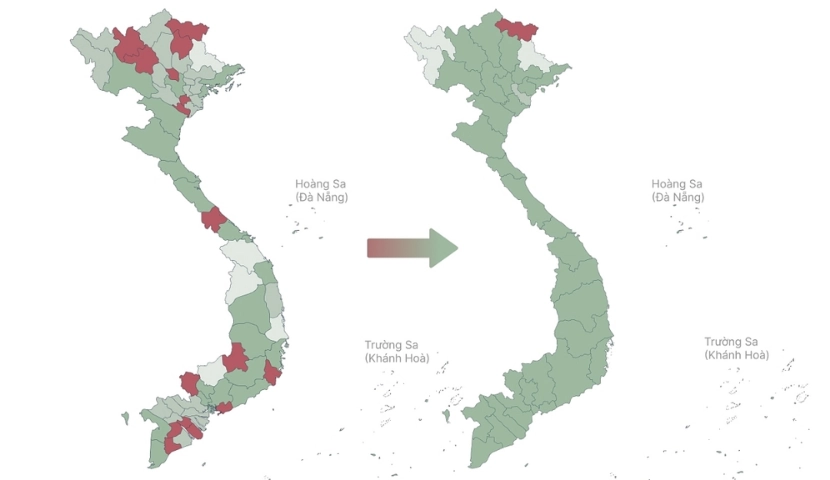
What the new map looks like: Mergers and “Unchanged” Zones
Provinces and cities that remain the same
Not all regions were merged. A set of provinces and cities — including Hanoi, Hue, Lai Châu, Điện Biên, Sơn La, Lạng Sơn, Quảng Ninh, Thanh Hóa, Nghệ An, Hà Tĩnh, Cao Bằng — were kept unchanged.
Some key mergers
Some provinces have been merged into larger units. For example:
- Tuyen Quang Province now includes the former Hà Giang Province and the old Tuyên Quang.
- Lao Cai Province now covers the area of the old Lào Cai and Yên Bái Province.
- Thai Nguyen Province now merges the former Bac Kan Province and old Thai Nguyen.
- A larger province called Phu Tho Province now comprises the territories of the former Phu Tho, Vinh Phuc Province, and Hoa Binh Province.
In total, 23 new provincial-level units were formed through mergers.
List of 34 provinces/municipalities of Vietnam (After 2025 merger)
Following the 2025 administrative restructuring, Vietnam now consists of 34 provinces and centrally governed municipalities. This reorganization aims to streamline governance, improve regional coordination, and support sustainable economic development across the country.
Several provinces and cities have been merged to form larger administrative units, while key urban centers continue to serve as regional capitals. The updated list below provides an overview of Vietnam’s current provincial structure after the 2025 merger, including newly formed provinces, merged administrative areas, and their respective capital cities.
| No. | New Province / City | Merged Provinces / Cities | Administrative City (Capital) |
|---|---|---|---|
| 1 | Hanoi | Hanoi | Hanoi |
| 2 | Hai Phong | Hai Phong + Hai Duong | Hai Phong |
| 3 | Tuyen Quang | Tuyen Quang + Ha Giang | Tuyen Quang |
| 4 | Lao Cai | Lao Cai + Yen Bai | Lao Cai |
| 5 | Thai Nguyen | Thai Nguyen + Bac Kan | Thai Nguyen |
| 6 | Phu Tho | Phu Tho + Vinh Phuc + Hoa Binh | Viet Tri |
| 7 | Bac Ninh | Bac Ninh + Bac Giang | Bac Ninh |
| 8 | Hung Yen | Hung Yen + Thai Binh | Hung Yen |
| 9 | Ninh Binh | Ninh Binh + Ha Nam + Nam Dinh | Ninh Binh |
| 10 | Cao Bang | Cao Bang | Cao Bang |
| 11 | Dien Bien | Dien Bien | Dien Bien Phu |
| 12 | Lai Chau | Lai Chau | Lai Chau |
| 13 | Son La | Son La | Son La |
| 14 | Lang Son | Lang Son | Lang Son |
| 15 | Quang Ninh | Quang Ninh | Ha Long |
| 16 | Thanh Hoa | Thanh Hoa | Thanh Hoa |
| 17 | Nghe An | Nghe An | Vinh |
| 18 | Ha Tinh | Ha Tinh | Ha Tinh |
| 19 | Hue | Thua Thien Hue | Hue |
| 20 | Da Nang | Da Nang + Quang Nam | Da Nang |
| 21 | Quang Tri | Quang Tri + Quang Binh | Dong Ha |
| 22 | Quang Ngai | Quang Ngai + Kon Tum | Quang Ngai |
| 23 | Khanh Hoa | Khanh Hoa + Ninh Thuan | Nha Trang |
| 24 | Gia Lai | Gia Lai + Binh Dinh | Pleiku |
| 25 | Lam Dong | Lam Dong + Dak Nong + Binh Thuan | Da Lat |
| 26 | Dak Lak | Dak Lak + Phu Yen | Buon Ma Thuot |
| 27 | Ho Chi Minh City | Ho Chi Minh City + Binh Duong + Ba Ria–Vung Tau | Ho Chi Minh City |
| 28 | Can Tho | Can Tho + Soc Trang + Hau Giang | Can Tho |
| 29 | Dong Nai | Dong Nai + Binh Phuoc | Bien Hoa |
| 30 | Tay Ninh | Tay Ninh + Long An | Tay Ninh |
| 31 | Vinh Long | Vinh Long + Ben Tre + Tra Vinh | Vinh Long |
| 32 | Dong Thap | Dong Thap + Tien Giang | Cao Lanh |
| 33 | Ca Mau | Ca Mau + Bac Lieu | Ca Mau |
| 34 | An Giang | An Giang + Kien Giang | Long Xuyen |
Why the government did this: Goals & Hopes
The reform reflects several major aims:
- Simplify bureaucracy and governance: By reducing the number of administrative units, the government expects to cut down on overlapping functions and make management more efficient.
- Optimize public investment and services: Larger administrative units can coordinate infrastructure, healthcare, education, and public services more effectively across a broader region.
- Enable long-term regional development: Bigger provinces may better attract investment and plan large-scale projects, which could boost economic growth and connectivity.
What it means for people – Opportunities & challenges
Potential positives
- Better planning & services: Unified provinces may offer improved infrastructure, more consistent policies, and better resource allocation.
- Economic growth: Stronger, larger provinces might draw more investment, which — over time — could bring jobs, improved transport, and growth in tourism or industry.
- Modernized administration: Fewer layers of bureaucracy might make procedures simpler for citizens and businesses.
Potential concerns
- Local identity & heritage: Merging different provinces may bring together communities with distinct cultures or traditions — raising concerns about preserving local identity.
- Uneven development: Rural or remote areas within a large province might be overlooked if focus shifts to more urban or central zones.
- Transition pains: Administrative changes — such as updating records, addresses, government services — may cause short-term confusion or delays.
What this means for travelers & locals
If you travel or plan to explore Vietnam in the near future, expect some changes:
- Maps (road maps, GPS, travel guides) will likely be updated to reflect the new provincial boundaries.
- Some places that used to have one “province identity” may now belong to a different or larger province — so check updated maps or official sources when researching destinations.
- Infrastructure and regional policies may change over time, potentially improving connectivity, transport, and tourism services in merged provinces.
- But some rural or lesser-known regions may face growing pains — amenities might evolve slowly, or some local services may be reorganized.
For locals, it means adapting to new administrative structures — but also possibly enjoying more efficient public services if the reform is implemented well.

Conclusion: A new chapter for Vietnam – Balanced and hopeful
Vietnam’s 2025 administrative reform is an ambitious step toward modernizing governance and streamlining regional development. For travelers, locals, and businesses, it brings both challenges and opportunities — from adapting to new provincial boundaries to enjoying improved infrastructure and public services. Whether you are planning your next trip or exploring hidden gems, this is the perfect moment to embrace a Vietnam Adventure. With clearer maps, better connectivity, and a fresh perspective on the country’s regions, every journey becomes more seamless, exciting, and memorable.

